Showing posts with label Adsense. Show all posts

Jan 24, 2009

Guide to Google AdSense Success


To know why Adsense is essential for your content sites is to know first how this works. The concept is really simple, if you think about it. The publisher or the webmaster inserts a java script into a certain website. Each time the page is accessed, the java script will pull advertisements from the Adsense program. The ads that are targeted should therefore be related to the content that is contained on the web page serving the ad. If a visitor clicks on an advertisement, the webmaster serving the ad earns a portion of the money that the advertiser is paying the search engine for the click. The search engine is the one handling all the tracking and payments, providing an easy way for webmasters to display content-sensitive and targeted ads without having the hassle to solicit advertisers, collect funds, monitor the clicks and statistics which could be a time-consuming task in itself.

It seems that there is never a shortage of advertisers in the program from which the search engine pulls the Adsense ads. Also webmasters are less concerned by the lack of information search engines are providing and are more focused in making cash from these search engines. The first reason why Adsense is essential for content sites is because it already has come a long way in understanding the needs of publishers and webmasters. Together with its continuous progression is the appearance of more advanced system that allows full ad customization. Webmasters are given the chance to choose from many different types of text ad formats to better complement their website and fit their webpage layout. The different formatting enables the site owners the possibility of more click through from visitors who may or may not be aware of what they are clicking on. It can also appeal to the people visiting thus make them take that next step of looking up what it is all about.

This way the people behind the Adsense will get their content read and making profit in the process. The second reason is the ability of the Adsense publishers to track not only how their sites are progressing but also the earnings based on the webmaster-defined channels. The recent improvements in the search engines gives webmasters the capability to monitor how their ads are performing using customizable reports that has the capacity to detail page impressions, clicks and click-through rates. Webmasters and publishers can now track specific ad formats, colors and pages within a website. Trends are also easily spotted. With the real-time reporting at hand, the effectiveness of the changes made will be assessed quickly. There would be time to sort out the contents that people are making the most clicks on. The ever-changing demands would be met while generating cash for the webmasters and publishers. The more flexible tools are also allowing webmasters to group web pages by URL, domain, ad type or category, which will provide them some accurate insight on which pages, ads and domains are performing best. The last and final reason is that the advertisers have realized the benefits associated having their ads served on targeted websites. Thus increasing the possibility that a prospective web surfer will have an interest in their product and services.

All because of the content and its constant maintenance. As opposed to those who are no using Adsense in their sites, they are given the option of having other people do their content for them, giving them the benefit of having successful and money-generating web sites. Adsense is all about targeted content, the more targeted your content is, the more target the search engines’ ads will be. There are some web masters and publishers who are focused more on their site contents and how best to maintain them rather than the cash that the ads will generate for them. This is the part where the effectiveness is working its best. There was a time when people were not yet aware of the money to be achieved from advertisements. The cash generated only came into existence when the webmasters and publishers realized how they can make Adsense be that generator. In those days, the content were the most important factors that is taken quite seriously. It still is. With the allure of money, of course.

Jan 20, 2009

Google Adsense guide for blogs


Sounds easy and yes, it is very easy. The only thing you will need is a blog (you should have it by now) and an Adsense account. Once your Adsense account got verified make sure to check out the interface and get used to some options. The Ad program is relatively easy to use, however, to become an Adsense Guru you will need to know a little more. I dedicated some time to work on a complete guide for Adsensel. I splitted it into several parts, each of them about a different topic.

  1. My first post is about the position of adsense units on you blog.
  2. The next guide will assist you on choosing the best ad colors.
  3. Next thing you will need are Adsense channels.
  4. You need to know whether you should use CPC or CPA Ads.
  5. And finally what the best ad programs for blogs are (other than Adsense).

So, go ahead, you got something to read. I have been working with Advertisements since 2007 now and still continue reading every day. Always remember, there is never the perfect solution, but there is a most suitable solution for your blog or website. You will need to test all advertisement programs to see which perform best for you. Depending on your website CPM advertisements might also be interesting for you. It is a very complex topic.

I was starting with Adsense only and then combined it with other advertisement programs. On one of my websites I experienced that CPM Advertisements seem to perform best for me (not a blog, a forum). Since then I am working together with Adsdaq, Tribalfusion, Adsense and CPXinteractive. The combination of all of them is what gets me most :-). Nonetheless, before you start thinking about all those other ad programs, make sure to read my Google Adsense guide first!

* AdSense Money AdSense Money Formula Revealed

_______________

A lot of people would like to know the success AdSense money formula. The simple formula below is one fundamental formula that you should know.

Money = sum ( [Price Per Click] X [Number of Click] )

Logically speaking, if you want to make more money, you have to either increase the number of clicks or the price per click. If you do one or the other you can make more money from the program.

Make More AdSense Money By Boosting the Number Of Click

Increase the number of clicks on your ads is the most obvious strategy that will make more money for you. There are two ways you can boost the number of click:

  1. Getting more traffic for your web site,
  2. Make your ads more clickable and position them at the right place.

Getting traffic takes time and efforts. It‘s also a lot of hard work. There are several techniques that you can use to generate more traffic to your web site and hence make more AdSense money. These techniques are:

  • Submit your web site to search engine and optimize your web site for search engine.
  • Increase link popularity by link exchange, article marketing, directory submission and press release.
  • Paid Advertising through classified advertising, banner advertising or search engine advertising.
  • Participate in forums/groups related to the content of your web site.
  • Add comments to other blogs.

Making your ads more clickable is another way to increase your earnings. It is relatively easy to do because you can adjust your ad format almost immediately. You can do the following adjustments to your ad format to improve your click through rate (CTR):

  • Make them more noticeable by positioning your AdSense ads on top of your AdSense page.
  • Google states that the most effective ad formats are 336×280 larger rectangle, the 300×250 inline rectangle, and the 160×600 wide skyscraper. However you should choose the best ad format that works for your web site. This requires tracking and testing.
  • Create a custom palette that best suites your web site. In general, you can follow the following settings:
    • Border color : no border or background color of your website
    • Background color : background color of your website
    • Link color : color of your links
    • URL color : black
    • Text color : black or color of your main content

Make More AdSense Money by Targeting the Higher-Paying Keywords

You can create unique, relevant and quality contents that target at the higher-paying keywords to increase your average price per click (CPC). Higher CPC means that you can make more money even the CTR remains unchanged. You should find out which keyword variations for a topic pay more. Often the more specialized variations and phrases pay more than the generic terms.

You can increase your CPC by reducing the occurrence of lower-paying ads. You can use AdSense competitive filter mechanism to filter out the ads that you don’t want to be shown on your web site. It is suggested by others that showing fewer ads on a page will result in higher-paying ads displayed on your web site. A lot of publishers report that they make more Adsense money if they remove ads completely from pages with few or no clicks. Again you have to test whether this strategy works in favor of you or not.

As you can see, it involves a lot of hard work if you want to make extra Google AdSense money. You need to put in your time and effort to make it happen.

What is Google Adsense ?


Google Adsense is one of the most successful online advertising programs today. This website is a guide to the Adsense program, that describes all major aspects, tips and optimizations of the program to help you have the best experience with Google Adsense.

As a webmaster, Google's Adsense program can be a possible income stream from your website, an income that can range from a few dollars to several hundred dollars a month....


Many hours have gone into researching the content for this website, and it will be constantly updated with the latest content related to Google Adsense.

The Google Adsense program is a great alternative, or even replacement, for the outdated banner programs. Today more and more internet users have gone "blind" to banner advertising, and thereby threatening your advertisement income as a webmaster.

Here is what Google writes about it's adsense program:

"Google Adsense is the programme that can generate advertising revenue from each page on your website—with a minimal investment in time and no additional resources.

Adsense delivers relevant ads that are precisely targeted on a page-by-page basisto the content people find on your site. And when you add a Google search box to your site, Adsense delivers relevant ads that are targeted to the Google search results pages generated by your visitors’ search request.

You can customise the appearance of ads, choosing from a wide range of colours and templates. You can do the same with your search results page. Your reports are customisable, too. Flexible reporting tools let you group your pages in any way you want so you can view your results by URL, domain, ad type, category and more to learn where your earnings are coming from."

Google Adsense ads, are highly content relevant ads, that are served directly on your pages - without your intervention. For you as a webmaster, this means that you simply paste the Google Adsense code on your pages, and thereafter have a constantly updated and relevant advertising income.

You can see an example of Google's Adsense on the top of this page.

The Google Adsense program serves ads generated by AdWords users on Adsense publishers webpage's. The Adsense ad layout can be fully customised to fit your excisting website design, in regards to both size, placement, colours and much more.

Jan 19, 2009

Adsense Tips for Bloggers 8 - Miscellaneous Adsense Tips

_______________

We have unpacked our Adsense Equation in detail and have given numerous tips for maximising Adsense Revenue. Whilst there are occasions that Adsense doesn’t perform as well on some websites for no particular reason as others we can safely predict that if you work on each of the four areas you should see an increase in the amount of the cheque that Adsense sends you at the end of each month. Remember though that your revenue will only be as high as your weakest link - work on all elements of the equation - not just one or two.

As well as the proceeding tips there are a number of other things that might be helpful to know in using Adsense that we couldn’t find a place for in previous posts.

Millions of dollars in online sales every day. Get your share.

Outgoing Links - One theory going around is that pages with fewer outgoing links result in higher click-throughs. Give your readers fewer options of links to click on and they are more likely to click on your ads. This MAY be true, but don’t let it determine your content. My Digicam site has many outward links because it is a page that acts as a hub of information from around the web. I’ve not noticed that this makes my revenue levels suffer - in fact I suspect its because of these helpful links that people come to my site.

Using Frames - If your site uses frames I’m told you should make sure your ads are placed in the frame where you content is or else it will not provide relevant ads for your content. Thanks Greg for this tip.

Don’t click your own ads. - It might be an obvious way to get a few click throughs and increase your Adsense revenue - but Google is very clever at working out if your clicks are genuine or not. Its not hard to track IP addresses and to see patterns emerging between where clicks are coming from. It is not worth the risk of being banned from the program for a few cents per click. Especially don’t click ads from the same IP address that you check your stats from - this is asking for trouble.

Don’t encourage your readers to click on your ads. Its against the agreement that you enter into with Google. Once again they will track you down if you break these rules. I’ve seen a number of people who have been banned from Adsense for this. Let your ads speak for themselves.

Monitor your Statistics. Many adsense users check their stats all day everyday. Whilst this might be overkill (its like watching grass grow) it is useful to track what is happening at this end of your campaign. Use channels to monitor which pages are doing well and which are not. Tweak pages that are not doing well and make more pages similar to those that do.

Alternative Ads - Use alternative ads for when Adsense cannot serve ads to your page. When they cannot find a suitable ad for your page Adsense will serve you with a ‘Public Service Announcement’ (PSA). These ads may be for a good cause, but they will not relate to the content of your page and will not earn you any money. Instead Adsense allows you to nominated an alternative ad that they will serve into the position instead of the PSA. I use Amazon for this, but also have experimented with affiliate alternative ads Affiliate Sensor which I find works really well as it lets you choose from a wide range of affiliate products and still target them to your site.

That is the end of our Adsense tips for Bloggers series. Feel free to submit your own Adsense tips and strategies in comments below. You also might like to check out some of the following alternative Adsense Tips pages for more tips from around the web. You might also like to check out the the Chitika eMiniMall Ad system which I make most of my income off these days. I reviewed it here and have a series of tips for getting the most out of your eMiniMalls.


Adsense Tips for Bloggers 7 - Well Placed and Designed Ads

_______________

Revenue = high readership + high paying ads + relevant ads + well placed and designed ads

The forth element of our Adsense Equation is that of having well designed and optimally placed Adsense Ads. I’ve found that ad positioning is incredibly important. I remember shifting the ads on one of my blogs a while back and being over the moon to discover the next morning that the move had doubled the click through rates that I’d had over night! Its worth doing some tweaking.

Adsense Ad placement and design is an issue that is often hotly debated in Adsense discussion forums. It seems that each Adsense user has their own strategy - some like ads that blend in, others like ads that stand out from the rest of the page. Some like ads in banner positions, others in skyscrapers, others like to put them right in the middle of content. In my experience, different strategies work on different blogs at different times. The key tip I’ll give you is to experiment. Try new positions and design and track your results. One of the best ways you can do this is by using Adsense Tracker which is an amazing tracking package for adsense which gives you much more control over what and how you track your adsense performance. It does cost to purchase the tracker but in my experience you’ll make your money back pretty quickly by using it to adapt your Adsense strategies.

Let me also share a few other tips that you might like to experiment with.

Blend - Most successful Adsense users seem to be taking the approach of blending their ads into the overall theme of their page. This often means making the ad’s background (and often border) the same (or similar) colour to the background of the page and making the title and URL the same as links of the rest of the page. In this way the ad does not stand out as being ‘ad-like’. Having said this I know of a few bloggers who take the opposite approach and make their ads as bright and ugly as possible in the hope of attracting the attention of their readers. I don’t subscribe to this because I think it cheapens the overall feel and look of a page.

In Content - More and more bloggers (and webmasters) are putting their ads inside the main body of their posts. In this way the ads are prominent and more likely to be seen by readers as they read your content. If your text wraps around the ads this can be quite effective. On the flipside of this argument is that you may run the risk of frustrating your readers with dominant ads. People reading content online are a fickle bunch and get easily turned off by blatant advertising.

Above the Fold - it is generally accepted that your Adsense ads should be placed towards the top of your page and be visable without your reader having to scroll down. Studies show that blog visitors stay on average for only 60 or so seconds, many without scrolling down. If you ads are hidden towards the bottom of your page you decrease the likelihood of them ever being seen let alone clicked.

Placement-4Left is Best - Google has put together a ‘heat map’ which is probably the best thing that you can look at when thinking about the positioning of your ads. You’ll see from it that they have found that ads on the left hand side of the page do much better than those on the right hand side.

Too Dominent? - The position and design of your Adsense ads needs to be balanced with the overall purposes and design of your blog. What is the priority of your blog - is it to make money or is it something else. I have a number of blogs - and place ads differently on each depending upon their purposes. For example this blog is not a commercial blog - I’m more interested in building relationships, sharing and hearing others ideas and updating those interested in what I’m doing with my life. As a result my Adsense Ads are in a less prominent banner position and are designed to fit with the overall theme of the blog. However on my Digital Photography Blog there is obviously a more commercial intent (as well as it being something of a passion and hobby). As a result I experiment with more prominent Adsense ads (usually skyscraper and within content).

I cannot stress enough how useful it is to experiment. What works on one blog doesn’t always work on another. I’ve also noticed that if you have a blog with regular and loyal readers that it is good to keep things changing as your readers tend to get used to the way your blog is and become blind to things like Adsense Ads. I notice that when I move my ads around that it often creates higher click throughs for a few days - until the blindness kicks in again. Joel Comm’s What Google Never Told You About Making Money with Adsense is an excellent E-book written with lots of good tips on positioning your adsense ads if you’re wanting to get another person’s opinion on this topic.

Adsense Tips for Bloggers 6 - Relevant Ads

_______________

Revenue = high readership + high paying ads + relevant ads + well placed and designed ads

The third element of our Adsense equation is that of relevant Adsense ads. It is all very well to rank high in search engines to generate high levels of traffic, but without relevant ads that relate to the content of your blog you are not likely to generate much in the way of click throughs.

Let me give you an example. Recently I was asked to help a fellow blogger who has struggling with his Adsense ads because whilst his content largely focused upon the topic of ‘health care’ - most of the ads being served to his blog were focused upon ‘blogging’. He was getting quite reasonable traffic levels and had a reasonably high paying topic (there are some good health care ads out there) but as you’d expect, people coming to a blog about health care did not click on ads for blogging software and services at a very high rate. The challenge was to get his ads reflecting the content of his blog.

Another fellow blogger had the problem of not getting ANY ads being served to his site. Instead of paying ads all he was getting was the public service ads that Adsense serves when they couldn’t find any relevant paying ads (these pay nothing).

How do you get relevant ads? Here are a few things to try.

Make sure there are ads available - My friend who didn’t get any paying ads served was focusing on a key word for which there was no or very few ads. A simple way of checking this is to do a search on Google for the key word you are targeting. If they don’t serve ads on their own search results page its an indication that such ads are scarce - if not non existent. They way we got ads on my friends blog was to experiment with other related keywords. He didn’t have to change the focus of his blog - just the way he described his topics. For example if there are no ads for ‘bed linen’ try ‘blankets’, ’sheets’, ‘quilts’ etc. Experiment with different combinations until you find something that works.

Increase your Keyword density - The more you use your keywords the more likely you are to get ads on those topics. Its not common knowledge exactly how the Adsense bot decides what ads suit your content best (if someone knows feel free to post it in comments below) but it’s a pretty safe bet that if you put you keyword in your title, at least once in your first paragraph and then scatter it throughout the rest of your page that you’ll convince the Adsense bot of what your topic is. It MAY also be helpful to include your keywords in the URL of your page (Moveable type can let you do this - ie look at the URL of this page - it incorporates my title and therefore some keywords). It MAY also be worth putting your keywords in outward links, bold, italics etc. All of these strategies also help optimise yor blog for search engines which won’t hurt either.

Examine your Sidebars, menus, header and footer - It is not just your main content that the Adsense bot searches to find the topic of your page, but also your other areas. When I looked at the healthcare blog that was getting ‘blogging’ ads I noticed that he had the word ‘blog’ in his title, three times on his sidebar and once in his footer. It was also in his URL and he also used the word quite often in his content. My recommendation was to remove the word from as many of those places as possible and to increase his health care keywords. The ads improved their relevancy almost immediately.

Stick to one topic per page - Obviously this may not be feasible on your front page - but attempt to keep each individual blog entry/post as highly targeted as possible. I’ve noticed that some people often include two or three topics in one entry - this will confuse Adsense’s bot so split them up into two entries.

Block irrelevant Ads - Sometimes despite your best intentions Google just gets it wrong and serves your ads that have nothing to do with what you write. If you’re getting some repeating irrelevant ads block them. Adsense lets you do this to quite a few sites and its easy to do. I have a number of ads blocked, some because they are philosophically not consistent with what I write about, but mainly because they just are not relevant to the topic of my blogs.

Ask Adsense - If all else fails notify Google Adsense of your issue. Of course they are busy people - but Google prides itself on being responsive to its users. I’ve emailed with queries a number of times, once on an issue of irrelevant ads, and every time I’ve had positive results from my query. You’ve got nothing to loose - shoot them an email!

If you do all of the above you SHOULD find Adsense serves you with relevant ads. In conjunction with the other elements in our equation this will contribute to increased click throughs and hopefully higher Adsense revenue. Next in this series on maximizing Adsense revenue is a post on Well Placed and Designed Adsense Ads.


Adsense Tips for Bloggers 5 - High Paying Ads

_______________

Adsense Revenue = Traffic Levels + High Paying Ads + Relevant Ads + Optimally Positioned and Designed Ads

The next element of this Adsense equation to be examined is how to get high paying Adsense Ads running on your site. Obviously in any business one way to get higher profits is to charge more for your product - whilst you have no direct say in how much is charged for ads run on your site - there are ways of targeting types of ads that might bring in a higher return than others.

As we mentioned in our initial explanation of the equation, the PVR Blog is one example of a blog that targets a well paying ad type - ads for PVR technology. Whilst I do not know specifics of earnings I would suspect blogs like Gizmodo who run Adsense ads would also be generating a higher paying ad, due to their focus on technology.

The lesson we can learn from blogs such as these is that they attract specific ads (that presumably are well paying) by keeping their content targeted on the same topics. To over simplify what we’re saying - if you want ads about Camera Phones blog about Camera Phones.

Finding High Paying Ads is not as easy as it sounds (is anything?). Do a search for Google on High Paying Adsense Ads and you won’t find too many sites listing the best keywords for Adsense. The top Adsense users in Adsense discussion forums tend to be pretty secretive about not only what keywords they focus on, but also what sites they run. I don’t blame them either - its good business sense really.

Having said this there are a number of strategies and tools that you might like to employ to help find high paying keywords.

  • Buy them - Finding high paying keywords for your blog is possible by yourself for free - but as with everything a few entrepreneurial types are willing to do the leg work for you to save you some time and give you a comprehensive result. One service that you might like to try to find good keywords is Top Paying Keywords.
  • Trial and Error - I know this will frustrate some of you who want a nice and easy quick fix but overall it is one of the best pieces of advice I can give. Try writing on a topic - track the results - if it pays off do it again….lots. Adsense allows you to track specific pages or sections of your blog using its ‘channels’ feature - if you’re smart you’ll watch which sections of your blog are generating the highest ads by dividing your overall earnings by the number of clicks and comparing it to other channels. Keep trying new topics until you strike gold and then dig in like crazy!
  • Are there Any Ads? - This is a good first question. Despite the many thousands of advertisers using Adsense there are some topics where the answer to this question is no. A simple way to check is to head to Google and do a search for the key words you’re wanting to blog about. The results page will bring up not only a list of other sites writing about that key word (they are you competitors) but on the right hand side there will be a list of ads - these are the same sorts of ads you’ll get on your site if you write on the topic. If there are ads there, it is a good sign. If there are not - maybe its worth finding another topic to write on if you’re hoping to attract ads.
  • 7 Search has a list of the 100 of the top paying keywords (in their advertising program - not Adsense) at the moment. Its a bit depressing actually to see a list like this because you’d have to sell your soul somewhat in order to go with many of them. Its an interesting site to check out though.
  • Also from 7 Search (and more useful) is their Keyword Suggestion Tool which gives you an idea of what people are paying per click on different tools (again this is not specifically for Adsense but it will give you an idea of what the going rates are). Find What also has a similar service.
  • Google Adsense’s biggest competitor are Overture (they run the ads on Yahoo) - they offer a service where you can enter your keywords and they will not only tell you how much advertisers are paying for the words but also how many people are searching for the term. This is a very useful tool.
  • Sign up for Adwords - One way of getting a feel for how much people are willing to pay per click is to sign up with Google as an advertiser yourself. It doesn’t cost much to start a mini campaign and do some research this way. You’ll get a feel for what people are bidding on different words very quickly this way.
  • Word Tracker is the best tool I’ve seen to help in finding keywords that people are searching for in the major search engines. The excellent thing about Word Tracker is that they also tell you how many other sites out there are targeting the same words! This is very handy as it will stop you targeting ‘Britney Spears’ as a Keyword phrase even though its one of the most searched for keywords on the web because literally hundreds of thousands of other sites have beaten you to the punch. Word Tracker has a free version to trial it and their paying version is even better - well worth the investment.

Targeting High Paying Adsense Ads is an important aspect of generating an income from Adsense. It is not enough in and of itself however. You can have $10 per click ads (I’ve not found any of these yet) but without generating any traffic your research into the right ads will be useless. Likewise it is one thing to identify which ads you want to target - but it is another thing to actually get these relevant ads showing on your site. It is to this topic which our next post in this series will head - Finding Relevant Adsense Ads.


Adsense Tips for Bloggers 4 - Increasing Traffic

_______________

Adsense Revenue = Traffic Levels + High Paying Ads + Relevant Ads + Optimally Positioned and Designed Ads

I now will turn my attention to each of the four elements of good Adsense revenue in turn and give some practical easy to implement tips to improve each from my experience.

Increasing Traffic Levels is a key component to increasing Adsense revenue. As I wrote previously, ‘The more people that see you Adsense Ads, the more likelihood there is that someone will click on them.’

Increasing the readership of your blog is not as simple as it sounds, it takes time, patience and hard work (and sometimes a bit of luck) Having said that there are many things you can do to get your blog in front of a wider audience and there exposing the adsense messages on your site to more potential ‘clickers’. Here are a few tips…

  • Quality, Interesting, Useful and Original Content - What are the blogs that you read the most? If you’re anything like me they are blogs that have quality content that ’scratches me where I itch’. This is essential to increasing your readership unless you have a pretty amazing ‘gimmick’ to bring readers in.
  • Good Blog Design is really important if you want your blog to create a good first impression. With millions of other blogs and sites out there its worth some effort to make yours stand out. Also worth a read is Good Weblog Design and Layout.
  • Link to others - be generous with your links to other bloggers big and small. You’ll be surprised how many links come back your way. This not only brings traffic from their sites but doesn’t hurt your ranking in Google.
  • Comment on others blogs - Some of my most loyal readers came to my blog because I genuinely interacted with them on their blogs through comments. Hear me now, I say genuinely because its easy to spam in comments, but this will have the opposite effect of generating readers to your blog.
  • Update Frequently - There is nothing that turns me off a blog faster than seeing that it hasn’t been updated for a month or more. Keep it rolling over with interesting content.
  • Interact with Readers - Having an interactive blog that invites the involvement of readers is one way of generating repeat visitors. I’ve written a tip on Interactive Blogging including a number of interactive tools that you can use on your blog. Also check out this tip on using comments effectively to increase interactivity on your blog.
  • Optimise for Search Engines - I can’t stress enough how important Search Engines are to increasing traffic, especially traffic that will click on your ads. I find that 95% of my traffic comes from Google and have found that anecdotal evidence suggests this traffic clicks through on Adsense ads at a higher rate than traffic from links on other blogs and sites. So work hard at getting listed and highly ranked on Search Engines.
  • Add a signature to your outgoing email - Learn a lesson from Hotmail who have used signatures on the bottom of their users emails for years to promote their home page and generate interest in their product. Be careful though if you don’t want your worlds to collide!
  • Web Rings - There are literally thousands of webrings that you can sign up for. I’m not sure how effective they are these days, but some people still swear by them.
  • Add an RSS feed to your blog - more and more people are reading blogs without ever visiting them through News Aggregators that pick up information using RSS. Whilst this does not guarantee those reading through aggregators will visit your blog (and therefore see your Adsense Ads) it certainly increases the chances of them dropping by, especially if you invite comments and have internal links on your posts.
  • List your site on Portals - There are a growing number of sites which exclusively list blogs. If you want people to find you its worth submitting your blog to be listed on them. Some focus on specific topics while others list blogs on a wide variety of topics (like Eaton Web and Globe of Blogs). Other portals like BlogShares and Blog Street also list a lot of blogs in different ways which might increase your blogs profile.
  • Blog Search Engines and Indexes - Get yourself registered on sites like Blogdex, Technorati, Popdex and Daypop (they require RSS I think). These sites have features that allow people to search for blog entries via topic and keywords. They also list the most popular recent topics and each have other interesting features which can enhance your blogging experience.
  • Start a Newsletter - Offer your readers a newsletter service to keep them up to date with your latest posts. I’ve found since adding a free weekly newsletter to my digicam blog that hundreds of readers have signed up for regular updates of my latest posts. Think about this - hundreds of people have given me permission to invite them to come back to my blog - every week!
  • Get Involved in Blog Projects and Memes - From time to time other bloggers will invite your participation in a blog project of theirs. Get involved, support their project and you might find it pays off. On the flip side start your own blogging project or meme. Do something that is of service to other bloggers. I tried something like this with Underblogs and Blogger Idol.
  • Get involved in other web forums - Genuinely participate in web forums and discussion pages on topics related to your blog. Many of these allow you to add a signature to your posts which raise your blogs profile.
  • Promote your Posts - If you think you’ve written something worthwhile spend a few minutes letting others know about it. I regularly shoot other bloggers to notify them of what I’ve written if I think it will interest them. Think about it before you send the email and don’t bombard the same people constantly with every topic you write on - be selective, concise, polite and helpful with your emails but don’t be afraid to promote yourself.
  • Add a ‘Email a Friend’ Option to your posts - make it easy for your readers to tell others about what you’ve written. I know this function gets used regularly on my blog and brings in new readers that I would never otherwise have been able to reach.

These are just some of the ideas that I’ve used and seen others use to increase the readership of a blog and thereby increase the exposure of Adsense ads to a wider audience.Many of the above tips were taken from my Blog Tips Series including the ‘Finding Readers’ Series.

What methods have your found to be effective at increasing the readership of your blog? What works for your and what doesn’t? What tips would you add to this collection?

Of course increasing traffic alone won’t greatly increase your Adsense revenue, but it can help! In our next Adsense Tip for Bloggers we will explore ways to generate High Paying Ads - the second component in our Adsense Revenue Equation.


Adsense Tips for Bloggers 3 - An Equation for Success

_______________

There are many factors that impact the level of revenue generated from a blog using the Google Adsense program. Books have been written explaining expert strategies for Adsense - However for the purposes of this series we’ve boiled it all down into four elements that we believe impact your Adsense earning capacity the most. Speaking in general terms here is a simple equation that illustrates how the factors each contribute to Adsense Revenue.

Adsense Revenue = Traffic Levels + High Paying Ads + Relevant Ads + Optimally Positioned and Designed Ads

Its not Rocket Science. Each of the above four elements contribute directly to the total revenue that your Adsense Ads will produce. Don’t just work on one of them though because if any one is weak it will hold your potential earnings back. Lets break each factor down….

Traffic Levels - The more people that see you Adsense Ads, the more likelihood there is that someone will click on them. As I examine the statistics provided by Adsense that report my daily earnings I notice that my earnings in the past 8 months have increased considerably as my total page impressions have increased. For example earlier in the week when Slashdot linked up to this post I had an influx of 50,000 visitors in 24 hours to my blog - it doesn’t take a genius to work out what this did to my Adsense earnings that day! Work on increasing your traffic levels and you should see an increase in your Adsense Revenue.

High Paying Ads - Once again I’m stating the obvious, but if the content you provide on your blog attracts high paying ads you’re going to do significantly better. For example it has been documented that the PVR Blog is doing pretty well when it comes to high Adsense earnings - the secret of its success is partly due to it being served with ads that are high paying. The topic of the PVR blog is, as you’d expect, PVR technology including TiVo, Replay TV etc. This is cutting edge technology and therefore advertisers are willing to pay top dollar to get their products and services out there! In comparison if a person was to start a blog on ‘toothpicks’ I suspect the ads are not likely to pay very much. It would take very high traffic levels to earn as much from a toothpick blog as it would the PVR blog.

Relevant Ads - A second reason the PVR Blog is successful is that it servers relevant ads. To put it simply people looking for information on PVR technology are confronted by Adsense ads for PVR technology. I recently visited a blog that was having trouble getting relevant ads - they had a blog on Tourist destinations in Australia - but unfortunately they were getting Adsense ads for remote control cars. You can guess what their revenue was like. Increase the relevancy of your Ads to your content and you are one step closer to increasing your Adsense revenue.

Optimally Positioned and Designed Ads - One of the coolest things about the Adsense program is that they give you freedom in choosing the best position and color scheme for your ads. Just like in the wider world of advertising - positioning is a key element to an ads success. A Billboard positioned on a road where no one drives is not likely to get the same results as one positioned on a busy intersection. The position and design of your Adsense Ads is critical - if they are out of site they’ll never get clicked on.

Bringing them Together - The above four elements are in many ways pretty obvious when spelt out like this - the challenge comes to improving each to optimize Adsense revenue.

Your revenue will only grow as high as the weakest one of these factors on your blog. For example if you have high paying, relevant, well designed and positioned ads but no traffic you’ll not do well. Likewise if you have high traffic, high paying and relevant ads but they are poorly designed an in a position where they’ll never be seen - you’ll waste all your other hard work. Its not enough to work on one element.

How do we improve each? In the next four posts we’ll examine each area in turn and suggest a number of ways that you might try tweaking them to increase your revenue.


Adsense Tips for Bloggers 2 - Is Your Blog Suitable for Adsense?

_______________

Google does not accept every site that applies to the Adsense program.

  • Google Adsense Program Policies indicate that the content of sites must not contain things like excessive profanity, pornography, illicit drugs etc. Basically your blog needs to have content that is reasonably ‘family friendly’.
  • Also in their policy document is a reference to them not normally accepting pages of a personal nature. This is the topic of discussion in many Adsense forums and is obviously open to different interpretations. Many (if not most) blogs are personal in nature - however to maximize your chances of approval by Adsense a blog should be targeted on a particular topic/s. For example whilst this blog is often personal in nature - most of my individual posts (pages) focus on very specific themes which are repeated throughout the blog. update - this may have changed recently with Blogger now allowing blogger blogs to use Adsense.
  • Sites accepted into the Adsense program are also required to be easily navigable, have an adequate quantity of text based content (don’t apply if you’ve been blogging a week) and be written in English, French, German, Italian, Dutch, Portuguese, Japanese, or Spanish. They may not to have excessive advertising or other contextual/competing advertising.
  • Whilst not stated in the Adsense Policy document, many also believe that sites accepted into the program also need to have reasonable levels of traffic. If your blog is new, it may be worth waiting a few weeks or months before applying to build up traffic and content levels. Others speculate that a professionally designed, well-organized and privately hosted blog has a better chance of being accepted. The more professional and successful your blog appears the more likely it is to be accepted by Adsense.

If still in doubt after reading Google Adsense Program Policies you can email Google for clarification or just apply and see how you go.

Of course, acceptance by Google into the Adsense program does not guarantee your success. The fact remains that certain blogs will always be more successful than others at generating income.

Future posts in this series will focus upon strategies and tips for increasing your revenue but it should be stated here that the most successful sites are generally sites with very high traffic levels and/or content that is directly related to a particular product or service (the more targeted and niche-like the better).

It is also worth saying that Adsense works best on pages with lots of text content. It only reads text in determining ads, not images so make sure you have enough relevant content.

AdSense

_______________

Adsense-BlogsWhen I survey bloggers about the methods that they use to make money from their blogs Google’s AdSense is always the number one response. It is a quick and easy way for bloggers of all sizes to display ads that are relevant to their content.
AdSense is a ‘contextual’ advertising program where publishers simply add a piece of code to their blogs that helps Google analyze what your page is about so they can serve ads on that topic. This increases the chances of your readers clicking the ad which increases the chances that you’ll earn something from them.

AdSense also provide a variety of other income streams to bloggers including a site search tool (you make money by people searching your site) and referral tools (where you can make money by recommending Google products).

AdSense is how I earn around 35% of my income as a full time blogger and I would thoroughly recommend it as a way of monetizing a blog - especially for those just starting out.

If you’re not already an AdSense publisher sign up for it using the following button.


Adsense Tips for Bloggers 1

_______________

adsense.jpgHow do you make money from the Google Adsense Program? What AdSense Tips can you share with us?

I have been asked this question so many times in the past few weeks that I thought I should write something on the topic. It seems increasingly bloggers want to try to cover their hosting and ISP costs with some revenue from their blog - and increasingly they’re doing it and are able to make a few (or quite a lot) dollars on the side. Many are turning to Google’s Adsense program.

Covering costs of my Digital Photography Blog is why I originally signed up with Google Adsense - blogging can get expensive when you have high levels of traffic and a lot of pages.

Whilst the agreement you sign with Google stresses that you are not allowed to give specific information about your earnings from the program I can say that I’m glad I’ve signed up because its well and truly covered my costs - and then some. In fact I think its quite feasible to expect that Adsense coupled with other strategies for making money from Blogging could quite easily generate a decent living. It takes time and hard work, but I think its very doable. (Update: Since writing this series I’ve revealed that I am now looking at making over a six figure income this year in 2005 from blogging).

So how do I make money from Google Adsense? Let me share some AdSense Tips that heve helped me.

This will be the first in a series of posts on this topic. Let me say up front I’m no expert - there are a lot of people out there making a lot more money than I am using Adsense - however most of them are not telling their secrets - well not for free anyway. I’ve got no secrets to hide and am willing to share what I’ve learnt since I signed up for the program 8 months ago. If you want a REAL expert’s opinion on Adsense I’d recommend buying Joel Comm’s What Google Never Told You About Making Money with Adsense E-Book. Joel earns $15,000 per month from Adsense and has some good things to share.

I know some bloggers are put off or offended by the idea of making money from blogging so I’ll try not to let these posts dominate my blog - however if you are not interested in the topic, simply skip over these posts.

I am going to assume a few things in this series to cut down the amount of introductory comments I have to make. Here is what I am assuming:

  • You have a blog. Whilst most of the following tips will apply to other types of websites I run Adsense on blogs and will speak from that experience.
  • You have (or will) read a basic overview of Adsense and have some understanding of what it is.
  • You have(or will) read the program policies as outlined by Google. These give details of site eligibility, ad placements and other requirements for using the system.

Enough introductory comments - lets get stuck into the Adsense Tips for Bloggers!


Jan 18, 2009

Adsense: Why is only one ad unit displaying ads?

_______________

The multiple ad units system detects the number of ad units that are on your page, and automatically serves unique ads to each ad unit. The system is optimized for pages that have highly targeted ads available - as a result, you may sometimes see that only the first ad unit contains ads. As our ad inventory changes, or if your page content changes, you may start seeing more ads on your page.

When only one ad unit is displaying ads, any additional ad units will display as transparent boxes, or will display the alternate ad or color that is defined in their ad code. Please note that each instance of ad code must have the alternate URL or color specified in order to display alternate content.

Adsense: Why aren't ads appearing on my site?

_______________


If ads are not showing on your site after you've added the AdSense code, make sure that the ad code is correctly implemented in your site. You can do this by viewing the source of your site from a browser and double-checking that the ad code looks exactly like the code we provide you in your account, and includes every line of the ad code.

There are a few common reasons why ads may not display on your website after correctly adding the AdSense code to your webpages.

  • Is JavaScript disabled in your browser?
    You will need to enable JavaScript in your browser in order to view Google ads on a website.

  • Do you have personal firewall software with an ad blocking feature or any other ad blocking software installed?
    Personal firewall software or ad blocking software can cause Google ads to not display, or may obscure portions of the ad. Any ad blocking features of your internet security software must be disabled in order to view Google ads.

  • Have you previously applied for the AdSense program and your site was disapproved?
    If your site was previously disapproved, our servers were instructed to not serve ads to your site. If that site (or another site associated with the same account) is later reconsidered and approved for the AdSense program, there may be a delay of up to 48 hours before all of our servers are informed of the change and ads begin appearing on your site.

  • Has the ad code been placed on pages with potentially adult or mature content?
    If ads are appearing on certain pages on your site but not on others, please ensure that the code has not been placed on pages with adult or mature content. We currently do not run Google ads on web pages that are determined to contain potentially mature or adult content by our automatic contextual advertising system.

  • Has your site previously violated an AdSense policy?
    Ad serving may have been disabled to your site because it wasn't compliant with our program policies. If this happened, a notification was sent to your AdSense login email or your contact email if you've specified another one.

  • Was your account found to pose a risk to advertisers or generate invalid clicks?
    If it was determined that your account posed a threat to advertisers or generated invalid activity, your account may have been disabled and you may no longer see ads on your websites. If this happened, a notification was sent to your AdSense login email or your contact email if you've specified another one.

  • Do you have too many ad units on your site?
    Our policies permit publishers to place the following number of ads on a webpage:

    • Up to three ad units
    • Up to three link units
    • Up to two Google AdSense for search boxes
    • One AdSense for video unit

    If you've placed more than the permitted number of ads on a webpage, ads will only show in the units that do not exceed the allotted amount.

Does AdSense code work within a PHP site?

_______________


While the AdSense code contains JavaScript variable declarations, it is actually a block of HTML code compatible with most PHP sites.

For help with implementing the ad code on a PHP site, we recommend searching for online resources using terms such as 'adsense php'.

If you need further assistance editing your HTML code, we recommend that your review our HTML online resources.

How do I add multiple ad units to my site?

_______________

Adding more ad units to your site is as easy as copying and pasting the ad code into your HTML source. Each ad unit can be customized with a different format, colors and more:

  1. Login to your account at https://www.google.com/adsense/
  2. Click the AdSense Setup tab and choose AdSense for content as the product.
  3. Select the ad type, ad format and any options you would like for your ads.
  4. Copy and paste the resulting ad code into the HTML source of your page where you feel another set of ads would be helpful.
  5. Add up to three ad units by repeating these steps.

Keep in mind that in addition to three standard AdSense for content ad units, you're also welcome to add more units to your pages. On any page, you can place:

  • three standard ad units
  • three link units
  • two search boxes
  • one video unit


Adsense: How do I add link units to my page?

_______________


AdSense publishers can add a up to three link units to any of their content pages that conform with our program policies. Adding a link unit is as easy as pasting a block of code into the source of your pages - follow the directions below to start showing this new form of text advertising on your website:

  1. Log in to your AdSense account at www.google.com/adsense
  2. Click the AdSense Setup tab
  3. and choose AdSense for content as the product.
  4. Select the link unit radio button and continue.
  5. From the Format drop-down list, select a link unit format and choose the radio button for showing 4 or 5 links per unit.
  6. Select your color palette and assign a channel and alternate ad to your ad unit, if desired.
  7. Copy and paste the ad code from the Your AdSense Code box into the source of your web pages. Please make sure that you copy the code in its entirety, and that you paste it into the body of your source.

Once you've updated your pages, link units will appear immediately. If we haven't yet crawled your page, we may initially show your alternate ad or a 'View ads about' search box in the link unit.


Where should I place Google ads on my pages?

_______________


The best location for Google ads varies from page to page, depending on content. Here are a few questions to ask yourself when considering where to position your ads:
  • What is the user trying to accomplish by visiting my site?
  • What do they do when viewing a particular page?
  • Where is their attention likely to be focused?
  • How can I integrate ads into this area without getting in the users' way?
  • How can I keep the page looking clean, uncluttered and inviting?
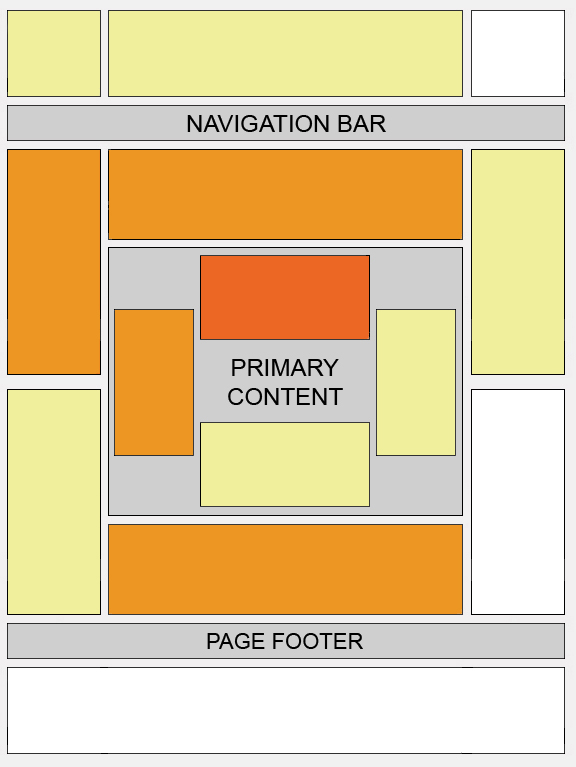
Certain locations tend to be more successful than others. This "heat map" illustrates the ideal placing on a sample page layout. The colors fade from dark orange (strongest performance) to light yellow (weakest performance). All other things being equal, ads located above the fold tend to perform better than those below the fold. Ads placed near rich content and navigational aids usually do well because users are focused on those areas of a page.

While this heat map is useful as a positioning guideline, we strongly recommend putting your users first when deciding on ad location. Think about their behavior on different pages, and what will be most useful and visible to them. You'll find that the most optimal ad position isn't always what you expect on certain pages.

For example, on pages where users are typically focused on reading an article, ads placed directly below the end of the editorial content tend to perform very well. It's almost as if users finish reading and ask themselves, "What can I do next?" Precisely targeted ads can answer that question for them.

Tip for forum webmasters and bloggers: Check out our specific tips on ad placement for forum sites and blogs.

How quickly will Google ads start appearing on my site?

_______________


After you've been accepted into the program and have implemented the HTML ad code on your site, ads will start running within minutes. If your site is not yet in our index, it may take up to 48 hours or more before we are able to crawl your site. Until your site has been crawled, we may display public service ads, for which you will not receive earnings.

Your ad relevancy should increase over time. However, keep in mind that if you make changes to a page, it may be 1 or 2 weeks before our crawler captures the changes and updates our index to provide more relevant ads.

Adding the AdSense for search code to your pages will instantly generate an AdSense for search box. As search results are displayed on Google-hosted pages, relevant ads will appear immediately, if ads are available for the particular query.